How to use GPT-6 Astra in your editor, and when not to
13 September 2026 | 4 min
Everyone has read the benchmarks. Almost nobody has said what it costs to actually point it at your repository for an afternoon.
GPT-6 Astra launched on 3 September 2026 and the coverage has been about scores. Useful, but it is not the question you have. The question is whether to run it against your own repository tomorrow, and that is a question about cost and fit, not about a leaderboard.
You can run Astra in AstraCode with your own OpenAI key. This is how, what it costs, and the cases where we would leave the choice to AstraOne instead.
Switching to it
Add your own OpenAI API key in AstraCode settings. A model picker appears under the composer; choose gpt-6-astra. Requests then go to OpenAI on your own account and do not count against your AstraCode plan.
Without your own key there is no picker, on any plan. AstraOne chooses the model: it runs the model measured to finish real repository work, and when a check fails it brings in a stronger one. The gateway enforces this on the server, so a client cannot ask its way around it.
| Plan | Without your own key | With your own key |
|---|---|---|
| Hobby | AstraOne | Not available |
| Student | AstraOne | Not available |
| Pro and above | AstraOne | Any model, Astra included |
| Teams | AstraOne | Any model, Astra included |
What one run costs
Here is the part the benchmark coverage leaves out. We measured one run of the smallest task in our benchmark, a single localized defect in a TypeScript repository fixed in 14 requests, then priced that exact token profile through every model at its published rate.
| Model | Modelled cost, one run | |
|---|---|---|
| gpt-6-astra | $3.16 | past its 272K cliff, so $20/$75 |
| claude-opus-5 | $0.81 | measured at $0.76 on the same task |
| gpt-5.6-sol | $0.65 | promotional rate to 2026-11-21 |
| claude-sonnet-5 | $0.32 | measured at $0.32 |
| gpt-5.6-luna | $0.03 | what AstraOne runs |
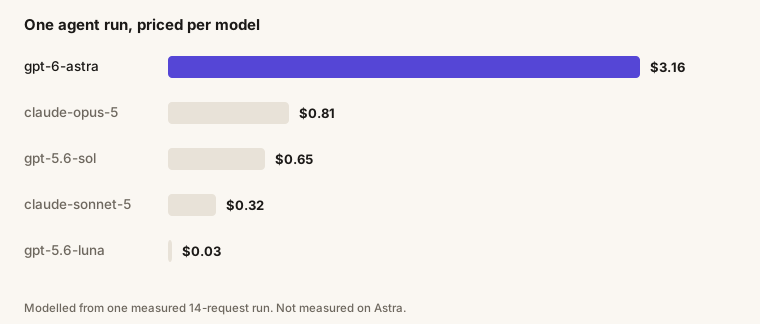
RUN_COST by ops/make-blog-figures.py, so it cannot disagree with it.These are modelled, not measured on Astra. The Opus row is the control: it models at $0.81 against $0.76 actually billed for the same task. Full token profile in the cost breakdown.
Astra is roughly four times Opus and a hundred times AstraOne's default on this task, and most of that gap is not the headline rate. It is the repricing at 272,000 prompt tokens, which a single small agent run clears by 50 percent. That is worth understanding before you leave it selected: why agent runs fall off the cliff.
When it is worth it
- Long-context work you would otherwise split up. A 1,050,000 token window means a large refactor can be one conversation instead of four that each lose the thread.
- Terminal and computer-use steps, where Astra's margin over the field is widest rather than a tie.
- The task that already failed twice. The cheap model that cannot finish is not cheap; it is the full price of your afternoon.
When it is not
- Anything mechanical. Renaming a concept across thirty files does not get more correct at $50 per million output tokens.
- Short, well-specified changes. The run above is exactly this shape, and Sonnet finished it for a tenth of the price.
- All day, by default. Leaving a frontier model selected for everything spends far more than most of the work needs.
Which is why AstraOne makes the choice by default. The right model changes per task, and AstraOne changes it on evidence, when a check fails, rather than leaving you to guess up front. Pick Astra yourself for the cases above.
A note on the meter
Most cost meters carry one rate per model. If yours does, every request past the cliff is billed at half what it cost. Ours had exactly that bug for grok-4.6 before it had the fix, which is why Astra's cliff went into a table both the gateway and the editor read, rather than a third special case somebody would miss.
Let AstraOne pick, or pick Astra yourself
AstraOne chooses the model on every plan. On Pro and above, bring your own key to choose any model, Astra included. Start free, no card.
Also on the blog
- When an AI agent says it is done and it is not
- How to review code an agent wrote
- Making an AI agent follow your project's conventions
- We benchmarked eleven models in our own editor. The cheapest one won.
- Fable 5.1 cut cache reads to $0.25. Here is what that saves on a real agent run.
- What vibe coding is, and when it stops working
- What Google Antigravity is, and what it costs
- What GPT-6 Astra actually costs to run a coding agent
- GPT-6 Astra's pricing cliff at 272K tokens, and why agent runs fall off it
- How we're benchmarking GPT-6 Astra for coding (and why scores won't tell you)